
Lukka Reference Data
A common language for digital assets: standardized digital asset data across identifiers, classifications, terms and conditions, events and entities.
Product sheet · Lukka Reference Data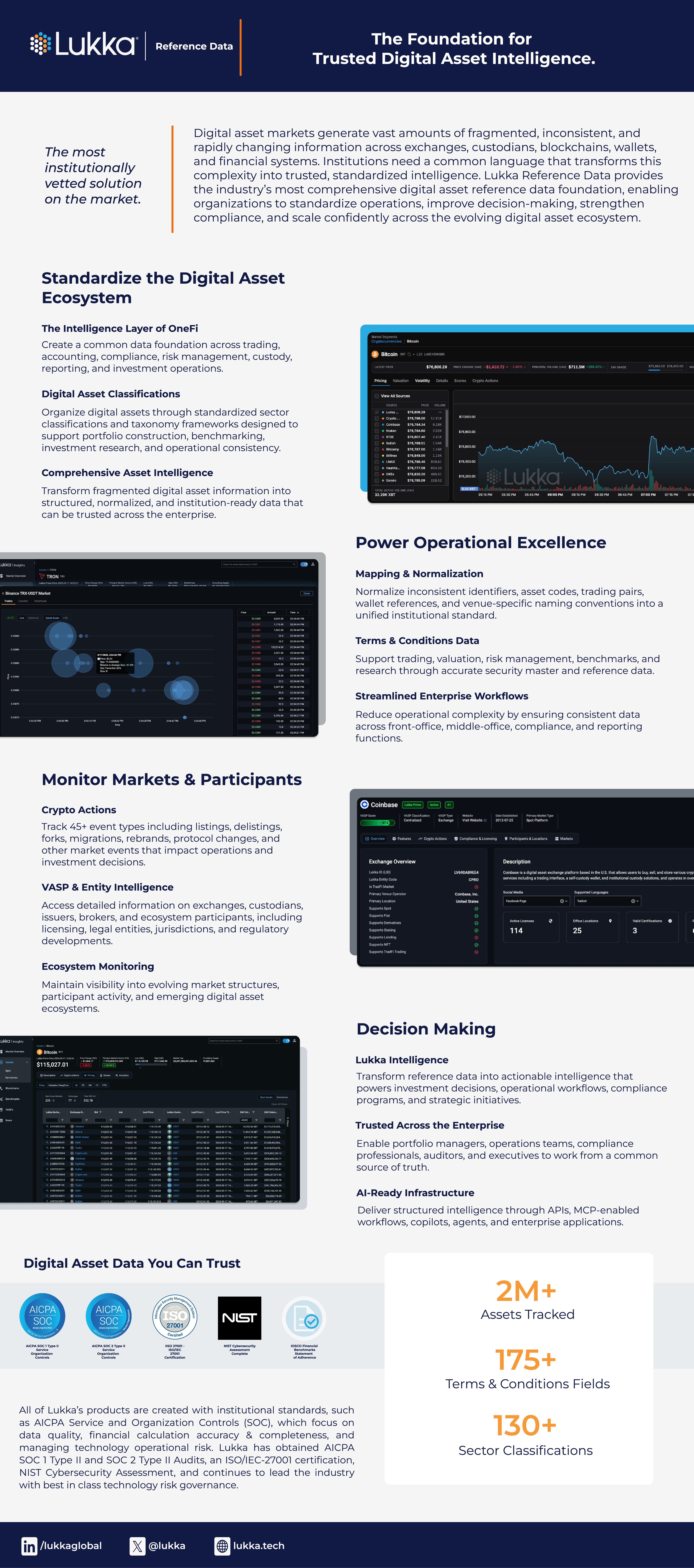
Digital asset data has no common language
Digital asset data is scattered across exchanges, custodians, blockchains, wallets and financial systems. It is fragmented, inconsistent and changes quickly.
The building blocks of standardized digital asset data
Mapping and normalization
Identifiers, asset codes, trading pairs and venue naming reconciled into one standard.
Classifications
Sector classifications and taxonomies for portfolio construction, benchmarking and research.
Terms and conditions
Security master data for trading, valuation, risk, benchmarks and research.
Crypto Actions
Listings, delistings, forks, migrations, rebrands and protocol changes.
VASP and entity intelligence
Licensing, legal entities, jurisdictions and regulatory developments.
AI-ready delivery
APIs, MCP-enabled workflows, copilots, agents and enterprise applications.
What teams gain
- Consistent data across front, middle and back office
- A shared source of truth for operations, compliance and auditors
- Less operational complexity
- Structured intelligence for investment and compliance decisions
Built for institutional teams
- Portfolio managers and investment operations
- Compliance, risk and audit teams
- Data, trading, custody and reporting teams
Lukka in numbers
Read the product sheet
See how standardized digital asset data simplifies every downstream workflow.
Standardized Digital Asset Data: FAQs
What does standardized digital asset data include?
Mappings and normalized identifiers, sector classifications, terms and conditions, crypto actions and VASP and entity data, delivered in one consistent format.
How is it delivered?
Through APIs, MCP-enabled workflows, copilots, agents and enterprise applications. See Lukka Reference Data.
How do I get started?
Contact our team to see how Lukka fits your workflows and systems.