

Two Regulators, One Week: What the Fed’s GENIUS Act Proposals and the SEC’s New FAQs Mean for Institutions
In a single week, the Federal Reserve proposed how bank-affiliated stablecoin issuers would be capitalized, reserved and supervised, and SEC staff clarified how securities law applies to a widening range of digital assets. Together, they turn digital asset strategy from a policy question into an operational one.
Part 1 of 3. Lukka’s three-part series summarizes and compares, and then digs deep into both.
For most of the last decade, the central question facing banks interested in stablecoins was whether they would be permitted to participate at all. That question is now largely answered. The harder question is how to participate in a way that satisfies examiners, auditors and counterparties from day one.
On September 24, 2026, the Federal Reserve Board requested public comment on two proposals that would establish its regulatory framework for Board-supervised payment stablecoin issuers under the GENIUS Act. One day later, the SEC’s Division of Corporation Finance published new staff FAQs on how the Commission’s March 2026 interpretation of the federal securities laws applies to certain crypto assets and transactions, including staking receipt tokens, token buybacks and post-launch network development.
The two actions come from different agencies and answer different questions. Read together, though, they describe the institutional operating environment taking shape for digital assets in the United States, and the data, controls and reporting infrastructure it will require.
Two Regulators, Two Lanes
It is easy to read headlines about “new stablecoin rules” and “new SEC guidance” as a single development. They are not, and the distinction matters for how institutions organize their response.
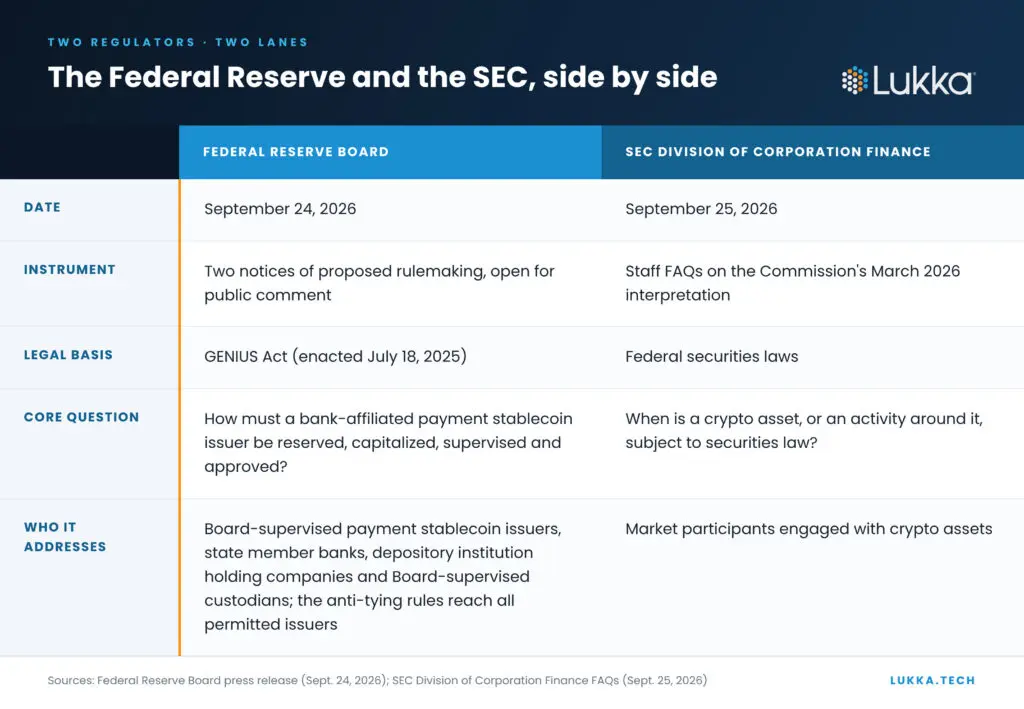
The Federal Reserve is acting as a prudential bank regulator. The GENIUS Act assigns federal oversight of payment stablecoin issuers across the banking agencies, and the Board’s proposals cover the issuers that fall under its jurisdiction.
The SEC is acting as a securities regulator. Its September 25 FAQs address when crypto assets and related activities fall within securities law; they are not focused on stablecoin issuance. The FAQs build on a March 2026 interpretation that sorted crypto assets into five categories: digital commodities, digital collectibles, digital tools, stablecoins and digital securities. Under that interpretation, qualifying payment stablecoins generally fall outside securities status.
The practical takeaway: a bank planning to issue a stablecoin will answer primarily to its banking supervisor for core elements of that business, including reserves, capital, redemption and risk management. But the same bank, as a custodian, market maker, lender or distributor, will also need a defensible view of how every other digital asset it touches is classified.
Why Both Matter
- For banks and prospective issuers, the Federal Reserve’s proposals define what it takes to issue: full reserve backing at all times, stablecoin-specific capital, two-day redemption, weekly reporting and annual examination.
- For custodians, platforms and distributors, the SEC’s FAQs shape how the rest of the book is classified, from staking receipts and wrapped tokens to assets whose issuers have completed their promised development.
- For compliance teams, auditors and regulators, both turn on evidence: reserves reconciled to on-chain supply, classifications documented with methodology and lineage, and activity that can be traced from source to report.
A third development connects the two lanes. On August 18, 2026, the FASB proposed guidance on when a stablecoin qualifies as a cash equivalent. Its test turns on redemption rights and reserve quality, the same features the GENIUS Act regulates, which means how an institution accounts for a stablecoin can depend on how it acquired it.
How We Got Here, and What Comes Next
The two lanes have been moving in parallel all year, and the next four months are dense with deadlines on both.
How we got here
- July 18, 2025: The GENIUS Act is enacted, creating the first federal framework for payment stablecoin issuers.
- February 25, 2026: The OCC issues the first comprehensive GENIUS Act proposal.
- March 17, 2026: The SEC’s interpretive release sorts crypto assets into five categories, including stablecoins.
- April 7–8, 2026: The FDIC proposes its prudential framework, and FinCEN and OFAC propose AML and sanctions rules for issuers.
- August 18, 2026: The SEC proposes Regulation Crypto Assets, and the FASB proposes when a stablecoin can count as a cash equivalent.
- September 15, 2026: The CLARITY Act stalls in the U.S. Senate in a 49-50 cloture vote.
- September 24–25, 2026: The Federal Reserve proposes its GENIUS Act framework, and SEC staff publish their crypto asset FAQs.
What comes next
- October 20, 2026: Comments close on Regulation Crypto Assets.
- November 19, 2026: Comments close on the FASB proposal.
- 60 days after Federal Register publication: Comments close on the Federal Reserve’s proposals.
- By January 18, 2027: The GENIUS Act takes effect, or earlier if regulators finalize rules sooner.
The Common Thread: Data Integrity
Strip away the legal architecture and a consistent pattern emerges. Proving full reserve backing means reconciling reserve records to token supply across every chain. Reporting weekly means identifying every contract and representation of a token. Classifying assets under the SEC’s framework means tracking what each issuer has promised and how that changes. Valuing holdings means striking a price from live markets rather than assuming $1.00.
Each of these is a data, provenance and controls problem, and it is where Lukka works. Lukka provides institutional-grade data, software and analytics for digital assets, with more than $4.4 trillion in value processed, built on three principles regulators are now writing into rules:
- Trust: enterprise-grade systems and controls, backed by AICPA SOC 1 Type I & II and SOC 2 Type I & II assurance
- Truth: accurate, normalized and verified data that holds up to scrutiny
- Transparency: clear lineage and explainability across on-chain and off-chain activity
In This Series
- Part 2: Federal Reserve Proposals examines what the Fed’s proposals would require of banks and stablecoin issuers, how they fit the wider GENIUS Act rulebook and what they mean operationally.
- Part 3: SEC FAQs examines what the SEC’s FAQs clarify, where their limits are and why classification is becoming a data discipline.
Build Your Digital Asset Strategy on Trusted Data
Whether you are preparing a stablecoin application, supporting reserve custody or classifying the digital assets you hold and distribute, Lukka can help you operate with confidence.
Contact us to learn how Lukka’s data, software and analytics support audit-ready, regulator-ready digital asset operations.
Disclaimer
This content is provided by Lukka, Inc. for general informational purposes only. It does not constitute investment, legal, tax, accounting, regulatory, or other professional advice and should not be relied upon as such. Nothing herein is an offer, solicitation, or recommendation to buy, sell, or hold any digital asset or financial instrument. Product features, capabilities, coverage figures, certifications, and availability are current as of publication and subject to change without notice; certain offerings may be in development or unavailable in some jurisdictions. Any references to laws, regulations, or frameworks are provided for context only, and Lukka does not guarantee any compliance, audit, tax, or reporting outcome, each of which depends on an institution’s own facts, controls, and obligations.
All trademarks, product names, and logos are the property of their respective owners.
© 2026 Lukka, Inc. All rights reserved.