FASB Adds Digital Assets Accounting To Its Technical Agenda

Author: Suzanne Morsfield, Global Head of Accounting Solutions in Academics

Today, the FASB voted unanimously to add a standard-setting project to their technical agenda on accounting for specific digital assets. They also voted not to include commodities in the project, but the Chair will keep it on the research agenda in a paused status at this time.

The next step will include establishing the exact scope of the standard-setting project, including which digital assets will be included. However, the project does not appear to only be focused on improving disclosures, but instead will likely cover recognition, measurement, presentation and disclosure. The Board was not in favor at this stage of a fair value option, but instead advocated for a fuller set of deliberations and decisions that would establish a valuation approach applicable to all the digital assets within the scope of the project.

Lukka welcomes the Board’s decision to add this project to their agenda. We support the thoughts shared by Chair Rich Jones May 4th at the Baruch College 20th Annual Financial Reporting Conference that convey the importance of authoritative standards that do not stifle innovation. In his words, “our standards benefit from a robust, thorough, and transparent process that results in high-quality standards that provide crucial decision-useful information to investors and other allocators of capital. Our standards are developed in full sunlight with the active participation of our stakeholders.” A formal project on digital assets will benefit from all of these attributes. Capital market participants ultimately will benefit from relatively more relevant and decision-useful information than is often provided under current interpretations of the applicable authoritative standards.

Some select observations made by Board members as part of their vote included:

  • The outreach and research by the staff added to the Board’s understanding of the digital assets, markets and exchanges, such that the members had greater assurance that the project was both needed and feasible.
  • The standard of pervasiveness was met, as one member noted, by the pervasiveness of digital assets in the economy at large, even if not in the number of public company Balance Sheets at present.
  • Most FASB members preferred a recognition, measurement, presentation and disclosure project, as opposed to a disclosure only or disclosure first project.
  • While there is current authoritative guidance to rely upon, many members felt the current accounting did not accurately reflect the economics.
  • The ongoing role of ASC 820 was acknowledged, but there was some diversity of opinion on how or whether it might need to be modified for digital assets.
  • Defining the scope of the project would be a very important step and would need to be done carefully.

The FASB Chair closed with a comment on the importance of providing unbiased and transparent information through the accounting, and not only through disclosure. Lukka is committed to high-quality standard-setting and will readily support our customers’ compliance with US GAAP and SEC reporting requirements, regardless of the direction and timing of standard-setting that follows from this decision. We also will support standard-setters and the standard-setting process in whatever ways we can.


About Lukka

Lukka is a firm that helps solve some of the greatest financial challenges in crypto and has the intellectual resources, along with the data and processing capabilities, to test hypothetical scenarios like the one here. For more information on how Lukka puts data to work across multiple finance sectors, traditional and decentralized, supporting industries from insurance to Formula E, go to our website at Lukka.tech


Section 6050I Guidance Updates

Author: Olya Veramchuk, Director of Tax Solutions

The US Department of Treasury and the IRS are working on an upcoming package of rules to implement through the infrastructure bill, signed in November 2021. However, according to Natasha Goldvug, Attorney-Adviser at the US Treasury Office of Tax Policy, the proposed regulations likely will not include guidance on a new requirement to report transactions involving more than $10,000 in cryptocurrency. Additionally, she  noted that the guidance on Section 6050I might be the next item addressed. 

Generally, Section 6050I outlines a reporting requirement for people who receive more than $10,000 in single or multiple related transactions while engaging in a trade or business. For example, a car dealer selling a car for at least $10,000 would be subject to this reporting requirement. Form 8300, used to report such transactions, must be filed with the IRS by the 15th day after the cash is received. Failure to furnish the form could result in criminal penalties. 

Section 6050I Guidance on Digital Assets

The amended Section 6050I proposed treating digital assets as “cash,” despite generally being treated as property for other tax purposes. The new information reporting must be supplied starting in 2024 for the tax year 2023.


The information contained in this bulletin provides only a general overview of current tax issues related to staking and shall in no event be construed as the rendering of professional advice or services. As such, the information provided in this bulletin should not be used as a substitute for consultation with professional advisors. Before making any decision or taking any action regarding your digital currencies or the tax treatment thereof, you should always consult with an appropriate, licensed tax, accounting, or other professional. To the fullest extent permitted by law, in no event will Lukka, Inc. (including its related entities, owners, agents, directors, officers, advisors, or employees) be liable to any reader of this bulletin or anyone else for any direct, indirect, or consequential loss or loss of profit arising from the use of this bulletin, its contents, its omissions, reliance on the information contained within it, or on opinions communicated in relation thereto or otherwise arising in connection therewith.

FY2023 Revenue Proposals: Summary of Provisions Related to Digital Assets

Author: Olya Veramchuk

On March 28, the Biden administration released the Fiscal Year 2023 Budget proposal together with the “Greenbook” from the US Treasury Department, which outlines a number of revenue proposals recommended to Congress. The four provisions related to digital assets are discussed below.

Expansion of mark-to-market rules to include digital assets

Under the current tax law, dealers in securities are required to apply the mark-to-market method to the securities held at year-end and recognize the resulting gain or loss. A mark-to-market election is available to dealers in commodities and traders in securities or commodities. This provision proposes adding digital assets as a separate category of assets, beyond commodities and securities, and availing the mark-to-market election to the dealers and traders in such assets. The rules would also cover the derivatives on the actively traded digital assets, similar to the existing rules for commodities and securities. It is worth noting that digital assets would not be treated as securities or commodities but instead will remain in that third separate category of assets.

The expansion of mark-to-market rules has the most impact on revenue of all the Greenbook proposals and is estimated to generate approximately $4.8b in the first year of the rule changes. Some have raised concerns about the projected revenue, considering that Bitcoin and Ethereum are already treated as commodities eligible for the mark-to-market election under the existing law.  Further, a high volume of trades, a short holding period, and the frequency of the portfolio turn-around are some of the main conditions of qualifying for a trader treatment for tax purposes. Thus, it’s not very likely that any meaningful built-in gains would be accumulated in trader portfolios.

The proposal would be effective for taxable years beginning after December 31, 2022.

Expansion of tax-free securities lending rules to include digital assets

Under the current US tax law, securities lending does not give rise to adverse tax implications, provided it is done pursuant to an agreement that satisfies certain requirements. The same is true for returning the loaned securities. The term “securities” includes traditional financial instruments, such as corporate stock, notes, bonds, and other similar instruments, but does not have any references to digital or crypto assets. Given the recent growth of the digital asset lending market, the Greenbook proposes amending the existing securities loan nonrecognition rules to include actively traded digital assets, provided the lending is done under terms similar to those currently required for lending securities.

This provision is estimated to have a negligible impact on the revenue. The proposal could be interpreted as an affirmation of the nonrecognition tax treatment many US taxpayers have already been applying to digital assets lending transactions.

The proposal would be effective for taxable years beginning after December 31, 2022.

Amendment of the information reporting rules to include digital assets

The existing information reporting rules stipulate a number of instances where certain information reporting, and often withholding, is required when foreign taxpayers are receiving US-sourced income or where there is US ownership of foreign accounts. The proposed changes expand the current reporting requirements for digital asset brokers and financial institutions. Brokers would be required to report gross proceeds and other information with respect to sales of digital assets by both US and non-US customers. Further, information concerning substantial foreign owners of certain passive entities would also have to be reported. The additional reporting would allow the US to share the information on an automatic basis with other jurisdictions pursuant to an international automatic exchange of information framework. In exchange, the US would reciprocally receive information on US taxpayers who, directly or through passive entities, engage in digital asset transactions outside the US.

This provision is estimated to generate about 10% of the total digital asset revenue in the first year after enactment. 

The proposal would be effective for returns required to be filed after December 31, 2023.

Amendment of foreign asset account reporting rules to include digital assets

The existing rules require any individual that holds an interest in one or more specified foreign financial assets with an aggregate value of at least $50,000 during a taxable year to disclose such ownership on their tax return. Currently, the term “specified assets” includes financial accounts maintained by a foreign financial institution and certain specified foreign assets not held in a financial account. Failure to provide such information without reasonable cause is subject to significant penalties. Under the proposal, a third category of assets – i.e., any account that holds digital assets maintained by a foreign digital asset exchange or other foreign digital asset service provider (a “foreign digital asset account”) – would be made subject to the reporting rules. Under the proposal, a foreign digital asset account would be defined based on where the exchange or service provider is organized or established, and effort would be made to coordinate this reporting requirement with others to minimize duplication. Further, reporting would only be required for taxpayers who hold an aggregate value that exceeds $50,000 for all three categories of assets. 

This proposal is estimated to generate about 10% of the total digital asset revenue in the first year after enactment, similar to the other information reporting provision. 

If adopted by Congress and signed into law by the President, the proposal would apply to returns filed after December 31, 2022.

Crypto Actions, Part 1: Blockchain Migration and Hard Forks

Author: Adam Katt and Olya Veramchuk

The term “corporate actions” is well known in traditional finance as an event by a public company that may affect the company’s securities and, consequently, its shareholders and bondholders. Examples include making a change to a company’s name, issuing a dividend, or even restructuring through a merger or bankruptcy. These transactions are familiar, have an established framework, and can be categorized and analyzed for different purposes, including taxation. 

However, the crypto ecosystem has introduced completely novel event structures to this framework that are highly focused on decentralized technology itself and can occur faster or more unpredictably. It is difficult to fathom a publicly-traded company splintering off into over 100 distinct entities with competing goals, but we know in the digital world, Bitcoin birthed more than 100 hard-forked assets in the 2010s. The dynamic and unprecedented ways in which digital assets can change and transform have brought a huge challenge to market participants: how does one categorize, analyze and prioritize events like hard and soft forks, migrations, airdrops, burns… and the list goes on. 

In addition, without a source of standardization, events as simple as ticker symbol changes may potentially create certain reporting issues for users.  The lack of consistency in how changes are tracked can lead to materially inaccurate tax lot matching, where such lots are created across entities using different ticker symbols to represent the same asset or, alternatively,  the same ticker symbol is utilized to represent different assets. This can make something as simple as applying a lot relief methodology challenging or not possible without first applying reference mapping data.  Bitcoin fork history illustrates the nearly impossible task of tracking newly formed assets and their respective naming conventions.

Just as in traditional finance, some “crypto action” events (as we call them at Lukka) are more impactful than others. When looking specifically at assets – rather than entities in the crypto ecosystem – crypto actions can broadly be categorized as either a complete change to an asset’s structure or as a change to its characteristics. Understanding the type and degree of change is important in facilitating analysis of the relevant tax, accounting, and legal implications. Here is a look at some crypto actions and the tax consequences they prompt.

Asset and Blockchain Migrations

Overview

Migrations are a constant occurrence in the digital asset space and can have a variety of effects on the structure of an asset. Assets can migrate from contract to contract on the same protocol and also from one blockchain platform to another, or both. Migrations can occur for multiple reasons, including bringing new assets into an existing product ecosystem, expanding support to new protocols, upgrading asset functionality, or movement of an asset from testing environments to production. 

An example that encompasses several of these scenarios is the migration that Project Hydro initiated last year. In this case, the project was looking to expand its reach and avoid high Ethereum gas fees by migrating HYDRO, its native token, to the BNB Chain. They also intended to respond to community feedback that the total supply was too large by reducing the supply and adding burn functionality to the asset smart contract. This was accomplished in two phases:

  1. Old HYDRO ERC20 tokens in personal wallets were migrated directly for new HYDRO BEP20 tokens at a 100:1 ratio (a migration between two blockchains). 
  2. The remaining old ERC20 HYDRO tokens were swapped for new ERC20 HYDRO tokens at a 100:1 ratio on a per exchange basis (a migration between two contracts on Ethereum).

As a result, there were two new versions of the HYDRO asset on different blockchains, and users who had previously held 100 old tokens now only held 1. The Hydro Project stated that the old HYDRO tokens were now obsolete. 

What this means from a tax perspective  

Generally, under the US tax principles, a realization event would occur when two conditions are met: there is a sale or exchange of assets, and the asset received is materially different in kind or extent from the asset given up1. Every instance should be reviewed on a standalone basis to determine whether there is a taxable event or not because the difference in the fact pattern may result in different tax treatments.

Consider moving an asset from the testing environment to production. It is unlikely that any assets are exchanged or there are any new features added. Consequently, it probably shouldn’t be treated as a taxable transaction. Similarly, enhancing existing assets with some new capabilities or improvements but not exchanging the original token iterations for the new and improved ones should not give rise to tax. 

However, an asset swap with a migration to a new blockchain would likely yield a different result. The HYDRO migration example outlined above clearly shows that the original tokens were exchanged for the new tokens at the 100:1 ratio. Further, because the new tokens had new capabilities as compared to the original tokens, it is reasonable to suggest that they were materially different from the original tokens. Thus, both realization requirements were met, resulting in a taxable exchange for the token holders. 

There are many other examples that are much grayer than the ones discussed. For instance, certain exchanges offer swapping ERC-20 versions of digital assets for the native ecosystem tokens (consider KuCoin facilitating the KAI swap). Note that this is slightly different from the so-called backdoor bridging offered by some centralized exchanges. There, the investors could deposit or buy tokens on one blockchain but withdraw them on a different blockchain. The key differentiator between a migration and a backdoor bridge is that a migration is an infrastructural change and not a permanent pathway designed to facilitate financial trading. 

The views on taxation of such ERC-20/native tokens swap vary. Some tax practitioners believe it is unreasonable to treat such swaps as taxable trades because the investor retains the benefits and burdens of owning the asset, and thus there is no exchange for tax purposes. We have discussed this issue in detail in our earlier blog.  

Other tax experts take a more literal view of the transaction and consider it an asset-for-asset exchange. Further, they look to the like-kind exchange guidance issued by the IRS last summer2, where the IRS maintained that every blockchain was “fundamentally different from each other.” Consequently, if an asset migrates from one blockchain to another, then it would likely gain new capabilities and therefore be materially different, resulting in a taxable transaction. There is no formal guidance on the matter. Thus, taxpayers are encouraged to discuss any points of contention with their tax advisors. 

Hard Forks

Overview

Hard forks are arguably the most (in)famous events in the blockchain ecosystem. There are many ways in which hard forks can be implemented. They generally involve a change to a single blockchain protocol that makes previous versions incompatible with that protocol going forward. Whether this revision is to implement new features or create an entirely new asset based on an old one, this new branch or “fork” of the blockchain protocol stems from the previous one. 

Although it is often the case, both branches do not need to be “adopted” for an event to qualify as a hard fork. While many hard forks are the result of divergent views on protocol management in which the community must choose which branch to support, many are part of planned upgrades in a blockchain’s development. 

Two very different examples of forking are the London hard fork on Ethereum and the Bitcoin Cash fork from Bitcoin. 

In the case of the London fork, Ethereum was implementing a network functionality upgrade that resulted in a new set of rules for transaction validators going forward. While a new branch of the protocol was created from a technical point of view, the old branch was deprecated, and only one Ethereum persisted in the market. 

The Bitcoin Cash fork from Bitcoin resulted from a disagreement between market participants on how the protocol should operate, thus giving birth to two completely separate assets. In 2017, holders of Bitcoin were credited with Bitcoin Cash when the fork occurred. Users of these crypto assets should consider these differences when analyzing their tax implications.

What this means from a tax perspective

Unlike many other issues in the digital asset space, tax treatment of hard forks was addressed by the IRS in the Revenue Ruling 2019-24, with some subsequent clarifications in the ILM 202114020 and FAQs on Virtual Currency Transactions. 

The IRS defines a hard fork as an event that “occurs when a cryptocurrency on a distributed ledger undergoes a protocol change resulting in a permanent diversion from the legacy or existing distributed ledger” and which “may result in the creation of a new cryptocurrency on a new distributed ledger in addition to the legacy cryptocurrency on the legacy distributed ledger3.” 

Consequently, it is important to distinguish between the events resulting in an airdrop of a new digital currency and those that do not.

Generally, when a hard fork is not followed by an airdrop of a new cryptocurrency, no taxable income should be recognized, and no reporting is needed. The Ethereum London hard fork discussed above is a great example of a non-contentious hard fork. 

In contrast, contentious hard forks followed by an airdrop of the new cryptocurrency result in ordinary income recognition under the current guidance. The assets received should be reported at the fair market value, provided the recipients have dominion and control over such assets, i.e., can, exchange or otherwise transfer them. This is illustrated by the Bitcoin Cash hard fork discussed above. 

To summarize, tax consequences and reporting requirements can vary quite significantly depending on the blockchain event. Therefore, taxpayers should always do the due diligence to understand what, if any, implications would apply.


  1. Treas. Reg. Sec. 1.1001-1(a)

  2. CCA 202124008

  3. Revene Ruling 2019-24


About Lukka

Lukka is a firm that helps solve some of the greatest financial challenges in crypto and has the intellectual resources, along with the data and processing capabilities, to test hypothetical scenarios like the one here. For more information on how Lukka puts data to work across multiple finance sectors, traditional and decentralized, supporting industries from insurance to Formula E, go to our website at Lukka.tech


Taxes Under the Bridge

Author: Olya Veramchuk, Director of Tax Solutions at Lukka


The ever-evolving digital asset ecosystem continuously generates new solutions, use cases, and offerings, resulting in the hundreds, if not thousands, of blockchains that exist today. Arguably not all of them have differentiated value, but the practicality of each offering is not the subject of this discussion.

While blockchain technology generally enables collaboration, coordination, and connectivity, each individual blockchain operates in a very siloed way. This is particularly relevant for the universe of decentralized finance (or DeFi): initially, native tokens only functioned on the parent blockchain without being able to communicate with other blockchains, which inhibited the opportunities offered by DeFi. Enabling cross-chain functionality via blockchain bridges is starting to help address the issue, allowing for network interoperability. This means that tokens, data, and smart contract instructions can be transferable between independent platforms, “allowing users to deploy digital assets hosted on one blockchain to dapps (or DeFi applications) on another, conduct fast, low-cost transactions of tokens hosted on otherwise less scalable chains, and execute dapps across more than one platform1.”

The mechanics of bridging and the LUNA example

Bridged assets do not exist on both blockchains simultaneously. Instead, the original asset gets locked on the parent blockchain, with an equal amount minted on the receiving blockchain. Upon redemption, the newly minted tokens get burned, and the original asset is unlocked. Typically, a small transaction fee is paid on each leg.

LUNA, the native token of the Terra protocol, is an excellent example of the bridging use case. When investors buy LUNA tokens on a centralized exchange such as Gemini or Coinbase, they purchase an ERC-20 version of the token. They can then withdraw LUNA into an Ethereum-compatible wallet and exchange it for the native version of LUNA using a bridge. The tokens can then be utilized within Terra protocol in a myriad of ways, including, but not limited to, staking, yield farming, purchasing NFTs, lending, or collateralizing for borrowing. 

Bridging capabilities prompt several tax questions:

  • Should bringing assets from one blockchain to another be treated as a taxable trade? Or can one argue that it should be tax-free? 
  • Are there any additional considerations that could influence the analysis? 

As mentioned in our previous blogs, existing tax guidance for digital assets is scarce and does not directly address any of the DeFi issues. Therefore, we need to look to the existing framework to analyze the tax consequences of token bridging. 

Is bridging a tax-free transaction?

Generally, for a realization event to occur under the US tax principles, two requirements must be satisfied: 

  • There should be a sale or exchange of an asset, and
  • An asset received should be materially different either in kind or in extent from the original asset contributed2

For tax purposes, a sale or exchange occurs when sufficient benefits and burdens of asset ownership are passed from one party to the other3

However, the investor’s interest in the underlying tokens is not transferred to anyone. Instead, the original tokens are frozen on the original blockchain, and identical tokens are minted on the new blockchain in a 1:1 ratio. The investor retains all exposure to economic upside and downside. Although at the first blush, there seems to be an exchange of the original asset for the new asset, it is not entirely so.

Even if bridging mechanics is viewed literally and considered a property exchange, the materially different requirement still needs to be satisfied to trigger a tax realization event. 

Traditional finance has a helpful analogy – an American Depository Receipt (or ADR). ADRs permit American investors to invest in foreign stocks, but without the complexities of dealing in foreign stock markets. Each ADR represents one or more shares of a foreign company stock held by a third-party depository bank. Investors who own ADRs are treated as directly owning the underlying stock for tax purposes.

ADR analogy could be applied to multichain assets. Just as the issuance of an ADR does not change the nature of the underlying stock, neither does the bridging of the asset from one blockchain to another. 

Further, the holder of the bridged asset can dispose of it at any time or convert it back into the original tokens, all while retaining the benefits and burdens of the asset ownership. Using the earlier LUNA example, the ERC-20 version of the token simply permits trading of the asset on the centralized exchanges, which treads close to the core principles of ADRs. 

Consequently, it is reasonable to suggest that bridging tokens does not yield assets that are materially different in kind or extent. Therefore, since neither the exchange nor the materially different requirements have been met, bridging should not give rise to a realization event. 

Wash Sales Washout

Separately, subjecting digital assets to wash sales rules, which defer loss recognition, and constructive sales rules, which accelerate gain recognition, was on the Congressional agenda at the end of 2021. Although not codified by the year-end, both provisions were viewed as revenue raisers and remain appealing as a topic for federal legislators to address at some point this year. 

This is significant for bridging activities. Were digital assets subject to these rules, and the US Treasury asserted that bridging should be treated as a taxable trade, DeFi participants could use bridging to circumvent the deferral and acceleration mechanisms by simply moving the tokens onto a different blockchain for a nominal fee. Analyzing transactions at the parent asset level (e.g., ETH as opposed to wETH/ETH) yields a more comprehensive picture of the activities. In this context, the asset holder attempting to find the path forward does not see bridging trigger realization. 

Is bridging a taxable trade?

However, despite the arguments presented above, it is conceivable that the tax authorities might take the opposite view.

As discussed above, a transaction would be taxable if both exchange and materially different requirements are met. The IRS may take a very literal view of a bridging transaction and argue that an exchange of assets occurs.

For example, in CCA 202124008 issued in June 2021, the IRS stated that “while [Bitcoin and Ether] share similar qualities and uses, they are also fundamentally different from each other because of the difference in overall design, intended use, and actual use.” This is because the Bitcoin blockchain was “designed to act as a payment network,” where the Ethereum blockchain was “intended to act as a payment network and as a platform for operating smart contracts and other applications.” 

Although there the IRS was discussing the application of the like-kind exchange4 rules to certain token pairs (i.e., swap of BTC for ETH and a few others), bridging could be viewed similarly and mean that moving assets across fundamentally different blockchains might be considered creating materially different assets. As such, both legs of bridging could then be treated as taxable trades.     

Conclusion

The digital asset ecosystem is vast, complex, and is growing at unprecedented rates, as do new service offerings. Investors must review asset functionality on each respective blockchain to determine whether a bridged asset undergoes some fundamental change that causes it to be materially different in kind or extent from the original asset, or whether bridging simply permits the asset to trade on a centralized exchange outside of the asset’s native ecosystem. 

As always, taxpayers should proceed with caution based on their personal risk tolerance levels and consult their tax advisers for reporting advice


About Lukka

Founded in 2014, Lukka serves the largest digital asset institutions through software and data solutions. Lukka bridges the gap between the complexities of blockchain data and traditional business needs. Its customers include Crypto Asset Exchanges and Trading desks, CPA and Accounting Firms, Fund and Financial Auditors, Fund Administrators, Miners, Protocols, individuals, and any other businesses interacting with crypto assets. All of Lukka’s products are created with institutional standards, such as AICPA SOC Controls, which focus on accuracy and completeness. Lukka is based in New York City. For information about Lukka, visit Lukka.tech.


  1. “What are blockchain bridges and why are they important for DeFi?” (https://blog.makerdao.com/what-are-blockchain-bridges-and-why-are-they-important-for-defi/)
  2. Treas. Reg. Sec. 1.1001-1(a)
  3. Grodt & McKay Realty, Inc., 77 TC 1221, 1237, Dec. 38,472 (1981)
  4. Sec. 1031

The information contained in this bulletin provides only a general overview of current tax issues related to staking and shall in no event be construed as the rendering of professional advice or services. As such, the information provided in this bulletin should not be used as a substitute for consultation with professional advisors. Before making any decision or taking any action regarding your digital currencies or the tax treatment thereof, you should always consult with an appropriate, licensed tax, accounting, or other professional. To the fullest extent permitted by law, in no event will Lukka, Inc. (including its related entities, owners, agents, directors, officers, advisors, or employees) be liable to any reader of this bulletin or anyone else for any direct, indirect, or consequential loss or loss of profit arising from the use of this bulletin, its contents, its omissions, reliance on the information contained within it, or on opinions communicated in relation thereto or otherwise arising in connection therewith.

A Brief Take on the Federal Reserve’s CBDC Report

The Federal Reserve published a highly anticipated whitepaper discussing the pros and cons of introducing a central bank digital currency (or “CBDC”). The Fed acknowledged that creating a CBDC would “best serve the needs of the United States by being privacy-protected, intermediated, widely transferable, and identity-verified.”

Fair Value Accounting for Actively-Traded Crypto Assets

Principal Market Identification and Beyond

Updated October 2022

Author: Suzanne Morsfield, Global Head of Accounting Solutions in Data & Analytics


The FASB just approved fair value accounting for specific crypto assets – Lukka’s ready, are you?

In its October 12, 2022 meeting the Financial Accounting Standards Board (FASB) voted unanimously to require fair value accounting for specific types of crypto assets. While this requirement may be new to some, Lukka has been rigorously supporting this accounting methodology for years, enabling its customers to pass their audits, whether they are striking NAV, marking to market, or testing for impairment. Underneath the hood of our fair value methodology is a foundation of high-quality data and a classification system that permits customers to further understand the types of crypto assets they are considering or are already holding–further, our data classification system allows us to help you assess whether a particular crypto asset is likely to be within scope for the new fair value requirement. And, for any crypto assets that are not within scope, Lukka’s impairment product facilitates daily, monthly, quarterly, or annual impairment testing and calculation at the push of a button.

Why do we need to talk about fair value for crypto assets?

The role of crypto assets in the global economy is both growing and evolving on an exponential scale. And whether a reporting entity (for-profit or not-for-profit) is simply holding these assets as investments, or using them in transactions, chances are the accounting concept of fair value will be applicable at some point in their financial reporting year. It is important to talk about fair value accounting because this accounting concept, and its measurement, can be mandatory for elements of a reporting entity’s financial statements and related disclosures. The requirement may be relevant for financial statement items that everyone recognizes, such as investments in publicly-traded securities; it can be equally important for the ongoing accounting valuation of items like a company’s trademarks or its crypto assets.

In a nutshell, fair value is a measurement approach that defines what to include or not in the reported amount of an asset in a company’s financial statements. However, it generally is not the same valuation as that performed by sell-side analysts. For accounting purposes, fair value measurement typically resides on a continuum–on one end there may be a relatively precise measure, driven by observable prices from a public exchange, and on the other end may be an estimation consisting of a model with inputs that are not publicly available. 

Regardless of where fair value falls on the continuum, the exact measurement of it, as discussed here, is confined by the guardrails put in place by global accounting standard-setters and regulators. Sometimes this guidance is very prescriptive, and other times, it may offer only principles. But, in all cases, reporting entities usually will need to find a path through the accounting fair value framework if they hold or use crypto assets. The discussion that follows provides some insights into that journey. 

Can crypto assets be reliably valued under existing accounting standards? 

This question has been puzzling to many in the financial reporting community, some of whom may wonder if the only way to value actively-traded crypto assets is by paying for custom valuation reports for each asset held or traded. The reasons for asking are valid and worth discussing. Lukka Prime answers these questions for actively-traded crypto assets with an institutional grade, AICPA SOC-certified, off-the-shelf, reasonably-priced commercial software product aligned with ASC 820 (US GAAP) and IFRS 13 (international). Its 5-step methodology has been reviewed and over the years used by top-tier academics, financial, accounting, and audit professionals. 

Just how challenging is the crypto ecosystem for financial reporting?

Among other statistics that illustrate the vastness and complexity of the crypto ecosystem, Lukka’s Reference Data product comprises:

  • 348+ Data Sources (e.g., exchanges, OTC desks, pricing sources)
  • 100,000+ Crypto Spot Assets 
  • 85,000+ Trading Pairs mapped

In addition to encountering this sheer volume and variety, imagine estimating fair value and providing a reliable audit trail in markets that: 

  • never close
  • aren’t regulated
  • include assets that can’t be directly turned into fiat currency
  • vary as to quality and volume/frequency of trades
    • importantly, variation can also occur within a market-i.e., the volume or frequency can change dramatically on a given exchange intra-day, not to mention daily.

But, what about existing accounting standards?

To no one’s surprise, the challenges of the crypto ecosystem create additional challenges for financial reporting, and for calculating fair value. Accounting standards for crypto assets are currently under consideration by global standard-setters and regulators; however, new or improved standards have not yet been formally addressed in an authoritative way. 

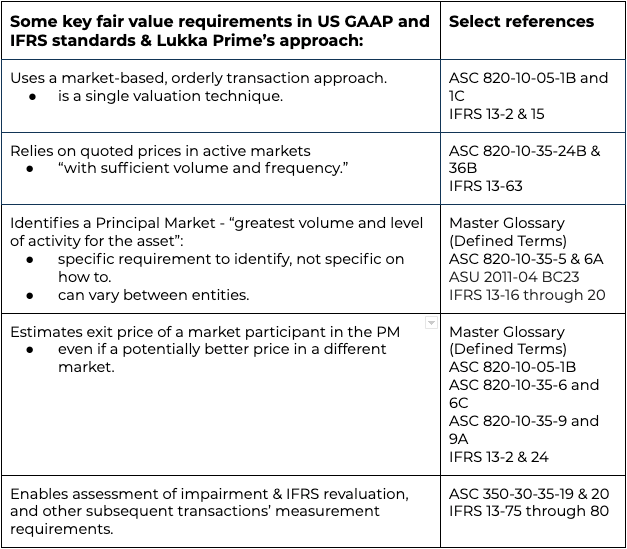
Meanwhile, many (including Lukka) believe that whenever crypto assets need to be valued, re-valued or impaired, existing fair value accounting standards are typically sufficient for most crypto assets. We list just some of the key requirements (and select references) by which Lukka Prime’s methodology aligns for actively-traded crypto assets here:

The challenges of the crypto ecosystem can further imply that technology and industry expertise are needed in order to provide a reliable valuation. Lukka provides both of these via its proprietary, but readily-available 5-step methodology.

What is the Lukka Prime 5-step Methodology? 

Our 5-step process dynamically identifies a Principal Market (per current accounting standards). The methodology then uses prices from that market to calculate fair value. These steps are followed by extensive oversight and monitoring of the data coming from the exchanges and through our own processors:

  • Steps 1 – 4 identify the Principal Market for actively-traded crypto assets by ranking the credibility and quality of each exchange (market) that meets our standards for governance and qualitative indicators (12+ at present); we use a dynamic proprietary ranking methodology based on volume and frequency of trades to identify the Principal Market for a particular actively-traded crypto asset or asset pair at a specific time. 
  • Step 5 identifies a Fair Value-based Exit Price, using the price for an actual transaction on this Principal Market at the specified point in time. This step then calculates fair value as exit price multiplied by quantity.
  • To ensure the quality of each Valuation, we constantly assess the prices and exchanges for data quality (e.g., volume, outliers, deviations, transparency, manipulation, etc); this monitoring is across the entirety of the data, is not a sampling technique, and is supported by a robust Pricing Integrity Oversight Board. 

And, how exactly does Lukka Prime identify a Principal Market? 

Our description of the challenges of the crypto asset ecosystem notes some of the specific challenges that make valuation under current accounting rules a further challenge. Identifying a reliable and auditable Principal Market is where the rubber really meets the road on this front; it is also the concept where most of the concerns lie about whether the current standards can actually be used effectively. 

In part, the way the ecosystem functions contributes to Principal Market identification concerns–i.e., if the volume and frequency of transactions can vary widely intra-day and across many exchanges for the same asset pair or asset, then how can a Principal Market possibly be identified? These questions led Lukka to co-sponsor data-driven research, now published in a peer-reviewed accounting academic journal. The study provided a rigorous, technology-based, and dynamic identification process. 

Who needs Lukka Prime?

Lukka Prime is relevant and effective for any reporting entity where a fair value is needed for transactions or holdings involving actively-traded crypto assets. Many discussions about accounting valuation of crypto assets begin and end with talking about figuring out what a particular holding is worth on the financial statements. However, crypto assets also can be used in a variety of subsequent transactions, from purchases to loans to staking and everything in between. 

Lukka Prime is a valuable tool for our customers for calculating fair value at each step of their crypto asset journey under current accounting standards. Some examples of what our method can assist with now include:

  • Fair value of crypto asset holdings under the new FASB requirement
  • Mark-to-market valuations and gains/losses
  • Impairment loss assessments and reporting
  • Revaluation calculations
  • Purchases or sales using crypto holdings
  • Crypto derivatives pricing
  • DeFi transactions that require accounting valuations
  • Fair value or basis for tax purposes.

Lukka supports the global standard-setting and regulatory bodies as they grapple with financial reporting answers. Our products will serve our customers’ needs whatever the direction and timing of their decisions.

Summary of the President’s Working Group Report on Stablecoins

President’s Working Group (“PWG”) on Financial Markets issued the long-awaited Report on Stablecoins on Monday, November 1, 2021. It is not entirely surprising that PWG focused their efforts on stablecoins – digital assets, the value of which are pegged to the traditional currency, – undeniably a low-hanging fruit in the crypto ecosystem. Certain stablecoins generated negative publicity earlier this year, when findings were published about the reserved asset composition, which revealed that not every token was backed 1:1 by USD or US Treasury bills. Instead, some held a high percentage of riskier assets in their reserves (i.e., other digital assets, commercial papers, corporate bonds, and others). 

The report acknowledged the proliferation and importance of stablecoins. In addition, it provided comprehensive coverage of the asset’s use cases, including vital importance to DeFi activities, such as lending, borrowing of other digital assets, trading, store, and transfer of value, all of which arguably would reduce the need for the traditional financial institutions. 

PWG identified the following risks related to stablecoin usage, which the regulators consider to be inadequately addressed “due to the lack of consistent risk-management standards among arrangements, the number of different key parties that may be involved in an arrangement, and the operational complexity of an arrangement”: 

  • Loss of value and stablecoin run risk, where lack of performance “according to expectations” would result in a “run”, defined as a “self-reinforcing cycle of redemptions and fire sales of reserve assets.” Prudential standards absent, risks to the broader financial system “could rapidly increase as well,” the report states. 
  • Payment systems risks, which essentially include all of the same risks that users in the traditional financial system are exposed to: credit risk, liquidity risk, operational risk, risks arising from improper or ineffective system governance, and settlement risk. However, because of the decentralized nature of many stablecoins, it is unclear who and what manner should be responsible for risk management. 
  • Operational risk, where “deficiencies in information systems or internal processes, human errors, management failures, or disruptions from external events” would result in the overall breakdown or deterioration of services. The regulators point out that “operational issues in a payment system can disrupt the ability of users to make payments, which can in turn disrupt economic activity.” 
  • Settlement risk, which means that a payment would not settle as expected. Because stablecoins lack clear definitions with respect to when the settlement should be considered final, credit and liquidity pressures for transaction participants the finalization of the settlement “heightened uncertainty and create credit and liquidity pressures for arrangement participants.”
  • Liquidity risk, which can arise as a result of operational misalignments between stablecoins and traditional systems, “causing temporary shortages in the quantity of stablecoins available to make payments.” 
  • Risks of scale, including systemic risk and concentration of economic power, which could “have detrimental effects on competition and lead to market concentration in sectors of the real economy” due to the lack of competition. 

Because stablecoins are not subject to a “consistent set of prudential regulatory standards” that would address and mitigate the risks outlined above, PWG suggests the following: 

  • Limit stablecoin issuance to entities that are “insured depository institutions” (i.e., banks) and prohibit others from doing so. As a result, “stablecoins would be subject to supervision and regulation at the depository institution level by a federal banking agency and consolidated supervision and regulation by the Federal Reserve at the holding company level.” This would address the user protection and run risks. 
  • Subject custodial wallet providers to appropriate federal oversight, including “authority to restrict these service providers from lending customer stablecoins, and to require compliance with appropriate risk-management, liquidity, and capital requirements”. That would address payment system risk. 
  • Further, any “affiliation with commercial entities” and use of transactional data should be limited. In addition, supervisors should have the ability to adopt standards to promote interoperability among stablecoins, or between stablecoins and other payment instruments. That would address the systemic risk and concentration of economic power. 

The regulators urged Congress to issue the relevant regulations as soon as possible. They also noted their continuing efforts at the FATF “to encourage countries to implement international AML/CFT standards and pursue additional resources to support supervision of domestic AML/CFT regulations.”